Because educational attainment is considered a measure of merit, officials scramble to obtain advanced degrees in order to gain an advantage in the competition for power.
The overwhelming majority of these officials end up receiving doctorates (a master’s degree won’t do anymore in this political arms race) granted through part-time programs or in the Communist Party’s training schools. Of the 250 members of provincial Communist Party standing committees, an elite group including party chiefs and governors, 60 claim to have earned PhDs.
Tellingly, only ten of them completed their doctoral studies before becoming government officials. The rest received their doctorates (mostly in economics, management, law, and industrial engineering) through part-time programs while performing their duties as busy government officials. One managed to complete his degree in a mere 21 months, an improbable feat, given that course work alone, without the dissertation, normally requires at least two years in most countries’ doctoral programs. If so many senior Chinese officials openly flaunt fraudulent or dubious academic degrees without consequences, one can imagine how widespread other forms of corruption must be.
Thursday, May 17, 2012
Chinese Meritocracy:

Wednesday, May 16, 2012
How often do we hear people say we must “get on the right side of history,” as if they know their own history? “When they say it, what do people mean?”...The problem is "the inevitable march of history" is an idea which ignores, for better or worse, individual agency. Individual freedom. From Jonah Goldberg's The Tyranny of Cliches, excerpted in NR.
They may mean “my side,” or “the good side,” or “the side that posterity will smile on.” People may be alluding to the ultimate triumph of liberal democracy. Or they may be alluding to the ultimate triumph of socialism, or a stricter form of collectivism. For generations, the Left has assumed that history marches with them: Get out of the way, or be crushed.
The phrase has what British historian Robert Conquest calls a “Marxist twang.” The Marxists believed that history was predictable and unidirectional, so of course there must be a right side and a wrong side to it. The candle makers were on the wrong side, the lightbulb makers the right side. But history doesn’t work like that. There were times when it was obvious that technology aided tyrants and there have been times— much like our own—when it seemed equally obvious that technology must liberate the individual. The truth is, it must do neither.
Sunday, May 13, 2012
Modern Slavery:
The price for a North Korean woman named Kim Eun-sun, her mother, and sister, to escape to China was 2,000 Chinese yuan, slightly more than $300. Like thousands of North Korean women before them, they crossed the Tumen River into China and met a woman who said she would help them escape –only to discover that they’d been sold to a Chinese farmer who wanted a wife.
Saturday, May 12, 2012
Natural Gas, the US and Russia:
Gazprom supplied 27 percent of Europe’s natural gas in 2011. While American gas is trading below $2 per MMBTU (million British thermal units), Gazprom’s prices are tied to crude oil markets, and its long-term contracts charge customers roughly $13 per MMBTU, says the FT. European customers would love to reduce their dependence on Gazprom and start to import American gas. Already Gazprom has had to make concessions to its three biggest customers, and others are increasingly dissatisfied with their contracts.It is important to note that shipping liquid natural gas overseas is dangerous and complicated, and the US doesn't have much infrastructure to do so, so that price delta isn't straightforward. But, Russia has spent most of the past decade holding Eastern Europe hostage with gas, so this is more of a direct affront to their power projection than any anti-missile plans that NATO may harbor.
Friday, May 11, 2012
The Wall Street Journal has an interesting editorial proclaiming that the right has officially captured the mantle of human-rights from the left:
Liberals and Democrats who work on human-rights issues won't like to hear this, but with the Obama presidency, human rights has completed its passage away from the political left, across the center and into its home mainly on the right—among neoconservatives and evangelical Christian activists.Most on the left would deny it, but the trend is very real. The editorial does perpetuate one myth though:
Conservatives didn't capture the issue. The left gave it away.
The official formulation of the left's revision of human rights came two months into the Obama presidency, with Secretary of State Hillary Clinton's widely noted comment in Beijing that the new administration would be going in a different direction: "Our pressing on those issues [human rights] can't interfere with the global economic crisis, the global climate change crisis and the security crisis."
Human-rights groups went ballistic, perhaps on hearing their cause would compete for the president's time with the "global climate change crisis." Whether Iran, Libya or China, human rights as understood for a generation was on the back burner, with the heat off.
Mr. Obama is a man of the left. His interests are local. The Democratic left can only be understood on any subject if placed inside one, unchanging context: the level of public money available for their domestic policy goals.The implication is that there is a significant amount of money for domestic spending to be found in the Defense budget. The problem is that the numbers don't back up this impulse. Even if we completely shuttered the Defense Department, we wouldn't close the budget deficit--in 2011, the total deficit was $1.3 Trillion when DoD spending was $712 Billion. We also live in a federal system. In the aggregate, state and local governments spend nearly as much as the feds. Keeping this in mind, defense accounts for only 14% of all spending. This is not to say that there aren't cuts to be made in DoD, only that the pie isn't as large as some think.
It's never enough. And standing between them and Utopia is a five-sided monument to American power across the Potomac... The Obama White House put a bull's-eye on the defense budget from the start.
Thursday, May 10, 2012
Libya:
“What do you want?” the commander said, clutching a length of industrial pipe.Absolutely fascinating piece on the state of the militias and government in Libya.
“What do you mean?” the prisoner said.
“What do you want?” the commander repeated. He paused. “Don’t you remember?”
Of course Najjar remembered. Until a few weeks earlier, he was a notorious guard at one of Col. Muammar el-Qaddafi’s prisons. Then Tripoli fell, and the same men he’d beaten for so long tracked him down at his sister’s house and dragged him to their base. Now they were mimicking his own sadistic ritual. Every day, Najjar greeted the prisoners with the words What do you want? forcing them to beg for the pipe — known in the prison by its industrial term, PPR — or be beaten twice as badly. The militia commander now standing behind him, Jalal Ragai, had been one of his favorite victims.
“What do you want?” Jalal said for the last time. He held the very same pipe that had so often been used on him.
“PPR!” Najjar howled, and his former victim brought the rod down on his back.
I heard this story in early April from Naji Najjar himself.
Libya has no army. It has no government. These things exist on paper, but in practice, Libya has yet to recover from the long maelstrom of Qaddafi’s rule. The country’s oil is being pumped again, but there are still no lawmakers, no provincial governors, no unions and almost no police. Streetlights in Tripoli blink red and green and are universally ignored. Residents cart their garbage to Qaddafi’s ruined stronghold, Bab al-Aziziya, and dump it on piles that have grown mountainous, their stench overpowering. Even such basic issues as property ownership are in a state of profound confusion. Qaddafi nationalized much of the private property in Libya starting in 1978, and now the old owners, some of them returning after decades abroad, are clamoring for the apartments and villas and factories that belonged to their grandparents. I met Libyans brandishing faded documents in Turkish and Italian, threatening to take up arms if their ancestral tracts of land were not returned.
Friday, May 4, 2012
The Crusades could more accurately be described as a limited, belated and, in the last analysis, ineffectual response to the jihad—a failed attempt to recover by a Christian holy war what had been lost to a Muslim holy war.Historian Bernard Lewis, via Jonah Goldberg.
Wednesday, May 2, 2012
Bobby Jindal's educational success:
Then the levees broke and the city was devastated, and out of that destruction came the need to build a new system, one that today is accompanied by buoyant optimism. Since 2006, New Orleans students have halved the achievement gap with their state counterparts. They are on track to, in the next five years, make this the first urban city in the country to exceed its state’s average test scores. The share of students proficient on state tests rose from 35 percent in 2005 to 56 percent in 2011; 40 percent of students attended schools identified by the state as “academically unacceptable” in 2011, down from 78 percent in 2005...
I visited the classrooms of Sci Academy, where 99 percent of the students are minorities and 92 percent are eligible for free and reduced-price lunch. They have some of the city’s highest scores on statewide tests, and more than 90 percent of Sci Academy seniors have already been accepted to a four-year college or university. At O. Perry Walker College and Career Preparatory High School, one of the first charters to open after Katrina, the mostly African American student body has turned in dramatic gains in achievement. (The school’s academic performance, as graded by the state, went from 48.1 in 2006-07 to 68.4 in 2009-10.)
Tuesday, May 1, 2012
Ukrainian children's song, 1931:
Father Stalin, look at thisAs quoted in Bloodlands, by Timothy Snyder
Collective farming is just bliss
The hut's in ruins, the barn's all sagged
All the horses broken nags
And on the hut a hammer and sickle
And in the hut death and famine
No cows left, no pigs at all
Just your picture on the wall
Daddy and Mommy are in the kulkhoz
The poor child cries as alones he goes
There's no bread and there's no fat
The party's ended all of that
Seek not the gentle nor the mild
A father's eaten his own child
The party man he beats and stamps
And sends us to Siberian camps
Remembering Victims of Communism Day:
The authoritative Black Book of Communism estimates the total at 80 to 100 million dead, greater than that caused by all other twentieth century tyrannies combined. We appropriately have a Holocaust Memorial Day. It is equally appropriate to commemorate the victims of the twentieth century’s other great totalitarian tyranny. And May Day is the most fitting day to do so.
Friday, April 27, 2012
Jonah Goldberg has a very sensible post on the Arizona immigration controversy:
If there were one thing I could impress upon people about the nature of the state, it’s that governments by their very nature want to make their citizens “legible.”
I borrow that word from James C. Scott, whose book Seeing Like a State left a lasting impression on me. Scott studied why the state has always seen “people who move around” to be the enemy. Around the world, according to Scott, states have historically seen nomadic peoples, herdsmen, slash-and-burn hill people, Gypsies, hunter-gatherers, vagrants, and runaway slaves and serfs as problems to be solved. States have tried to make these people stay in one place.
But as Scott examined “sedentarization” (making mobile people settle down), he realized this practice was simply part of a more fundamental drive of the state: to make the whole population legible to the state. The premodern state was “blind” to its subjects. But the modern state was determined first to see them, and then organize them. This is why so many rulers pushed for the universal usage of last names starting around 1600 (aristocrats had been using family or clan names for centuries already). The same goes with the push for more accurate addresses, the standardization of weights and measures, and of course the use of censuses and surveys. It’s much easier to collect taxes, conscript soldiers, fight crime, and put down rebellions if you know who people are and where they live.
Thursday, April 26, 2012
David Bernstein schools Dahlia Lithwick on basic history:
Actually, support for women’s suffrage didn’t break down along Progressive/non-Progressive lines. For example, Senator George Sutherland of Utah, later to gain fame as a “conservative” Supreme Court Justice, introduced the women’s suffrage amendment in the Senate. His “progressive” Supreme Court colleague, Louis Brandeis, was not a feminist and was a belated and somewhat reluctant supporter of women’s suffrage.
With regard to the Equal Rights Amendment, it was drafted by Alice Paul and the National Woman’s Party with advice from, you guessed it, George Sutherland. While some feminists who were also progressives supported the ERA, individuals who primarily considered themselves progressives, such as reformer Florence Kelley, opposed the ERA because it made no exception for “protective” labor legislation that only applied to women. Prominent Progressives like Felix Frankfurter condemned “the Alice Paul theory of constitutional law, which is to no little extent a reflex of the thoughtless, unconsidered assumption that in industry it makes no difference whether you are a man or woman.”
Conservatives looked at the Constitution in the 1920s and 1930s and thought it chock-a-block with ill-advised amendments. There was plenty of grousing on the right about the 14th and 15th (establishing civil rights for African-Americans),
Putting aside the fact that “conservative” natural-rights believing Congressmen pushed these amendments to begin with, it was progressives (again including Brandeis), not conservatives, who wanted to repeal the Fourteenth Amendment in the 1920s. While progressive objections primarily related to the protection of property and contract rights under the amendment, the Supreme Court’s first major case enforcing the Fourteenth Amendment to the benefit of African Americans, Buchanan v. Warley, met with general condemnation in Progressive circles.
Wednesday, April 25, 2012
What are the returns to education?

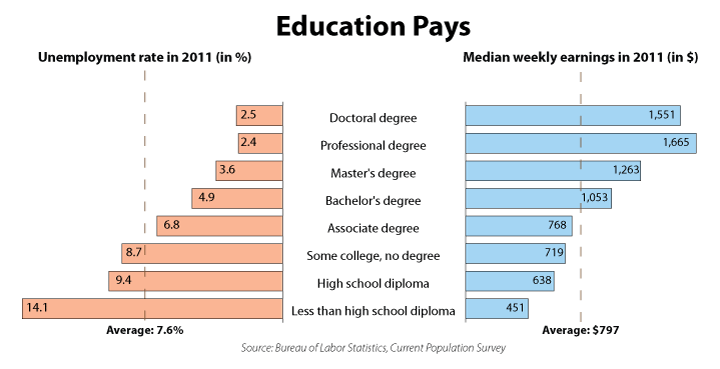
To start with, note that the data are 2010 median weekly earnings for persons age 25 and over, and earnings are for full-time wage and salary workers. So, everyone is lumped together—regardless of age, the school they attended, their major discipline, their academic performance, and even the field in which they’re working. And anyone working part-time is excluded entirely.
Breaking the data down further is illustrative. Among workers making $20,000 or less annually, 6 percent have master’s degrees or higher, 14 percent have bachelor’s degrees, and 9 percent have associate’s degrees. Among those making between $20,000 and $35,000 annually, 5 percent have a master’s or higher, 15 percent have a bachelor’s, and 11 percent have an associate’s degree...
Earnings also vary greatly depending on the student’s major. Data from the U.S. Census Bureau show that median earnings run from $29,000 for counseling-psychology majors to $120,000 for petroleum-engineering majors.
Is it “worth it” to spend the time and money for a degree in petroleum engineering? If you can do it, probably “yes.” But is it “worth it” to get a counseling degree? That’s far from clear.
Tuesday, April 24, 2012
Recent excitement in Beijing opens a window on Chinese Politics:
Behind closed doors, it is fair to assume that politics in China are no less vicious than in the Rome of Julius Caesar. The sacking on March 15th of Bo Xilai as party chief of the south-western region of Chongqing provided a rare glimpse inside those doors. The son of Bo Yibo, a leader of the Party’s Long March generation, Mr Bo had seemed destined for the zenith of power in China—the nine-member standing committee of the party’s Politburo. His downfall represents the biggest public rift in China’s leadership for two decades. There are reasons to celebrate it; yet the manner of his going is a sharp reminder of what’s wrong with China’s political system...But, there's a lot of backstory to this little affair, well laid out by Foreign Policy:
Welcome, too, is the little window the affair opens into the corrupt, fratricidal ways of party politics. Mr Bo’s downfall was precipitated by the flight to an American consulate of Wang Lijun, his former police chief and right hand in the anti-mafia drive. Mr Wang is now under investigation in China. Mr Bo, too, may soon find himself answering awkward questions. That Chongqing’s dirty linen was aired in front of American diplomats on his watch may matter more than the dirt itself.
Wen Jiabao and Bo Xilai have long stood out from their colleagues for their striking capacities to communicate and project their individual personalities and ideologies beyond the otherwise monochromatic party machine. The two most popular members of the Politburo, they are also the most polarizing within China's political elite. They have much in common, including a belief that the Communist Party consensus that has prevailed for three decades -- "opening and reform" coupled with uncompromising political control -- is crumbling under the weight of inequality, corruption, and mistrust. But the backgrounds, personalities, and political prescriptions of these two crusaders could not be more different.
Bo has deployed his prodigious charisma and political skills to attack the status quo in favor of a more powerful role for the state. He displayed an extraordinary capacity to mobilize political and financial resources during his four and a half year tenure as the head of the Yangtze River megalopolis of Chongqing. He transfixed the nation by smashing the city's mafia -- together with uncooperative officials, lawyers, and entrepreneurs -- and rebuilding a state-centered city economy while shamelessly draping himself in the symbolism of Mao Zedong. He sent out a wave of revolutionary nostalgia that led to Mao quotes sent as text messages, government workers corralled to sing "red songs," and old patriotic programming overwhelming Chongqing TV.
From his leftist or "statist" perch, Bo has been challenging the "opening and reform" side of the political consensus that Deng Xiaoping secured three decades ago. Wen Jiabao, meanwhile, who plays the role of a learned, emphatic, and upright Confucian prime minister, has been challenging the other half of Deng consensus -- absolute political control -- from the liberal right. He has continuously articulated the need to limit government power through rule of law, justice, and democratization. To do this, he has drawn on the symbolic legacies of the purged reformist leaders he served in the 1980s, particularly Hu Yaobang, whose name he recently helped to "rehabilitate" in official discourse. As every Communist Party leader knows, those who want a stake in the country's future must first fight for control of its past.
Until last month Bo appeared to hold the cards, with his networks of princelings -- the children of high cadres -- and the gravitational force of his "Chongqing Model" pulling the nation toward him, while Wen's efforts had produced few practical results.
Subscribe to:
Posts (Atom)